
Finding a Good Backcountry Partner
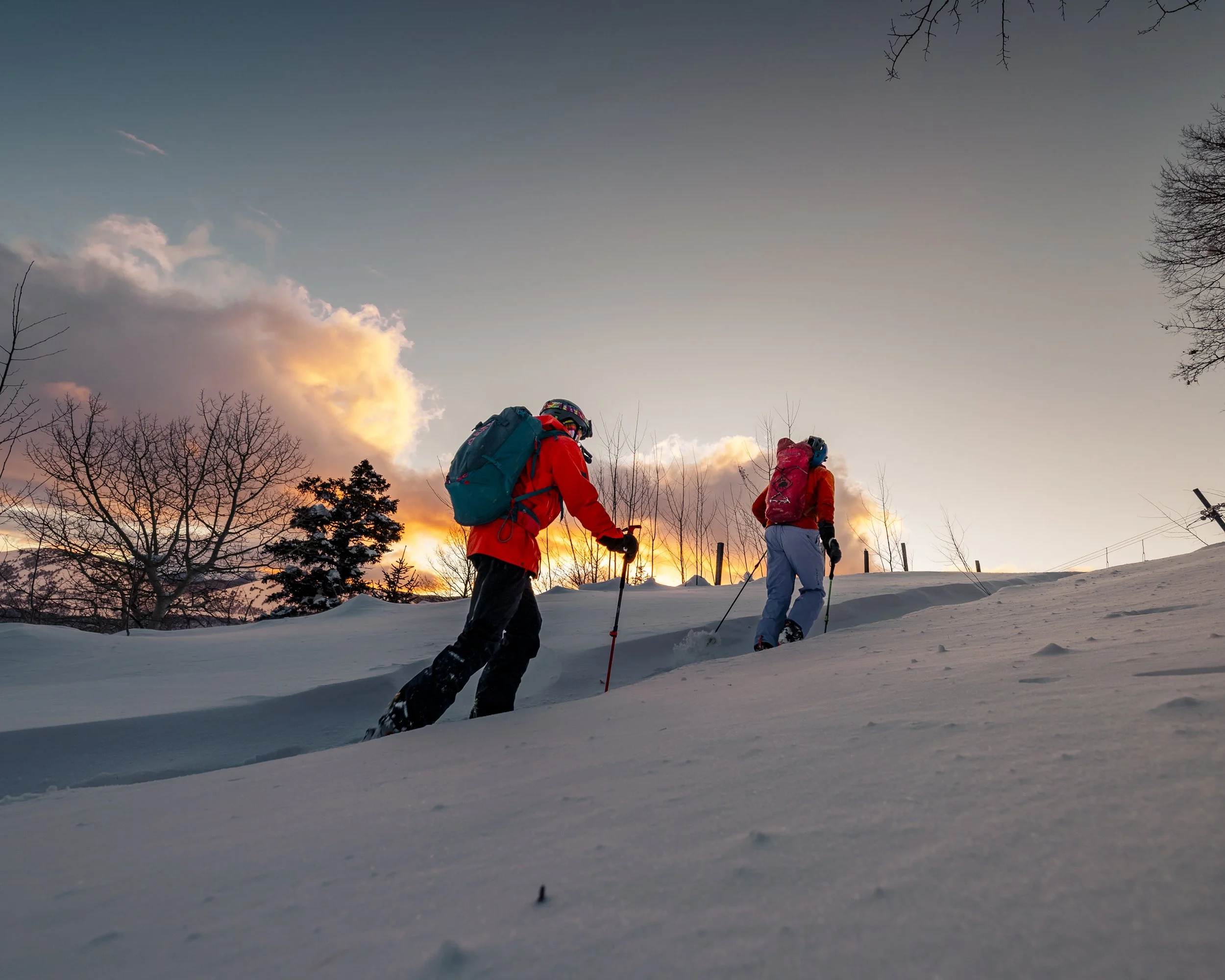
Simon Bantugan and Jeff Banks showing what it means to be a “dynamic duo” on the sunrise skintrack.
Photo: Reilly Kaczmarek
Shared Values, Shared Summits
Jeff Banks | IFMGA Guide | CEO & Founder, AspectAvy
Over the years I’ve noticed something simple: a great partner makes everything easier. A mismatched partner makes everything… educational.
Avalanche terrain has a way of revealing relationship dynamics faster than any personality test. I’ve skied with people I adore in the valley who, under a fresh two feet of snow sitting on a spicy old layer, suddenly feel like philosophical opponents. Nothing clarifies differences quite like shooting cracks and a well-timed whumpf.
One thing I’ve learned is that liking someone and traveling well with them are not the same skill set. I’ve chosen partners because they’re funny, thoughtful, share my interests, or can debate coffee foam with conviction. All wonderful traits. None of them help much when you’re standing beneath a loaded slope trying to decide whether “just one quick lap” is insight or impulse.
What’s mattered more, in my experience, is how our values line up when the stakes are real. If I’m honest, I’ve caught myself motivated by things that don’t exactly strengthen group decisions: freedom, independence, the pull of a bold line, the quiet desire to prove something. Those impulses aren’t unusual, but I’ve learned they can make consensus fragile if they’re running the show.
After a few decades of touring, and a generous supply of humbling moments, certain partner qualities have consistently made days feel smoother and decisions feel clearer.
I’ve learned to value communication that’s plain and timely. Saying what we notice, what we feel, and what gives us pause has saved more time than any clever route.
I’ve learned that empathy keeps conversations productive. When a partner’s concern lands as useful information instead of resistance, the whole tone shifts.
I’ve learned that courage often looks quiet: asking a question, slowing the group down, or suggesting we turn around when momentum says go.
I’ve learned to appreciate emotional steadiness, the ability to stay reasonable when cold, tired, hungry, or behind schedule. It’s rarer than deep powder and twice as valuable.
And I’ve learned that compatible risk tolerance doesn’t mean identical thinking. It just means our boundaries overlap enough that decisions don’t become negotiations every hour.
If there’s one pattern I keep noticing, it’s that good decisions often happen before we touch a shovel. I used to think clarity would come from digging one more pit or gathering one more data point. Sometimes it does. But just as often, the turning point is interpersonal: a question that lands, a doubt that gets voiced, a pause that resets the group.
When those pieces don’t line up, friction shows up quickly. I remember a dawn patrol on an all-time classic line: 3,000-plus feet of pristine powder, sunrise lighting the bowl, the kind of day that writes itself into memory. At the top, we ended up in a full-blown argument about rescue gear. Voices rose, time ticked toward work, and the descent was quiet in all the wrong ways. We never toured together again. It was a vivid lesson in how partnership can shape the entire day, often more than the snowpack does.
Another thing I’ve learned is how persuasive we can be with ourselves. The mind has a familiar rhythm: we feel something, we build a story around it, and then we present that story as logic. Partners who are willing to gently challenge that process, to ask “why” one more time, have saved me from my most convincing arguments.
After thirty years moving through avalanche terrain, the value that stands out most isn’t boldness or even knowledge. It’s humility. The snowpack is complex and endlessly variable: different across aspects, elevations, and terrain features. Certainty feels good, but it’s rarely durable. What has felt durable is partnership built on shared values: people who can hold doubt without panic, confidence without stubbornness, and goals without tunnel vision.
So if there’s a theme that keeps surfacing in my own experience, it’s this: the right partner doesn’t eliminate uncertainty, they help navigate it. They turn tension into information, hesitation into conversation, and good days into repeatable ones.
And that’s why, season after season, choosing a Backcountry Valentine still feels like one of the most consequential decisions of the day.
Knowledge Test: Avalanche Safety Tools
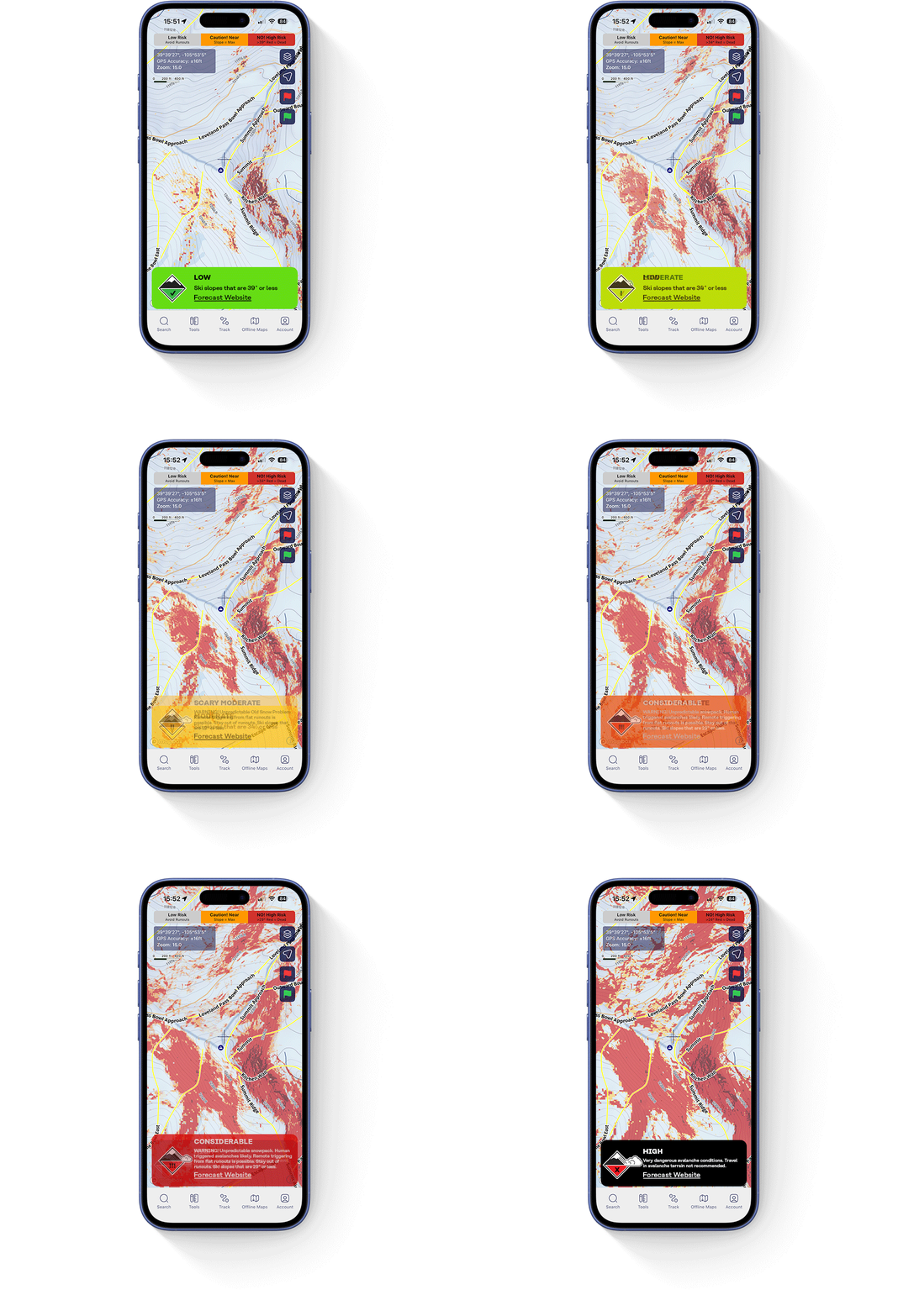
AspectAvy’s Adaptive Slope Shading. Notice the change in amount of red (high-risk) terrain.
What is Adaptive Slope Shading? Why is it useful?
Adaptive Slope Shading in AspectAvy is basically slope shading that adapts. Traditional map shading just shows steepness and leaves the avalanche interpretation to you; great in theory, less great when you’re hungry, excited, or negotiating group dynamics. Adaptive Slope Shading updates the map using the current avalanche forecast, dynamically shading terrain that matches today’s avalanche danger level.
Red shading = slopes that align with today’s higher-risk conditions. Clear areas = terrain unlikely to produce avalanches under the current forecast. Instead of memorizing forecasts and translating them mentally, the map visualizes them for you in real time.
It doesn’t replace all the decision-making, but it removes a lot of friction and reduces interpretation errors. Think of it as a second set of eyes that doesn’t get summit fever or low-blood-sugar logic.
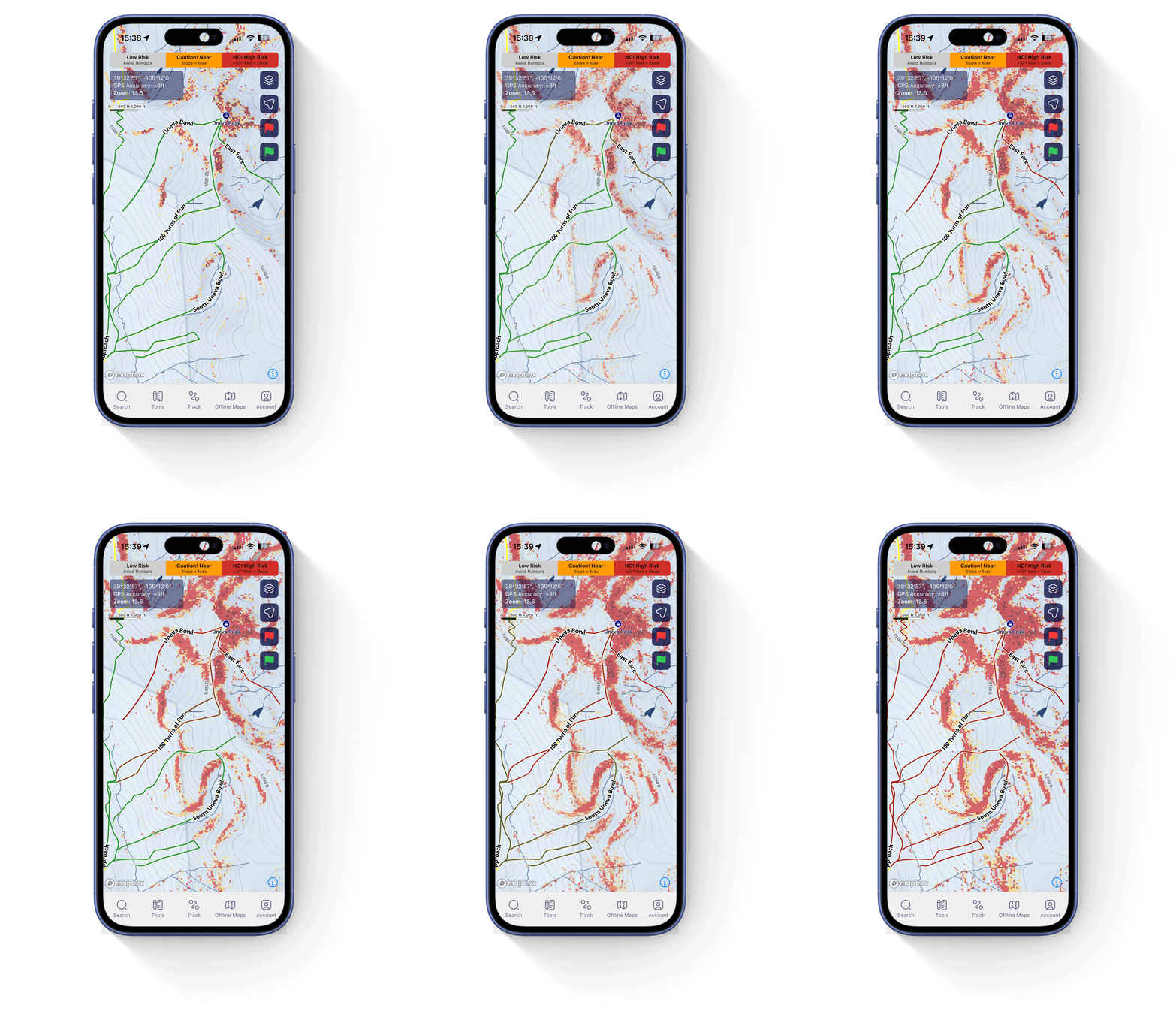
Red/green routes in AspectAvy. Notice how the routes change color!
What are Red/Green Routes? Is that like ski resorts?
Pretty much—except the grooming report is replaced by avalanche science.
Routes are evaluated against the adaptive shading. If a route crosses enough red terrain to exceed a risk threshold, the entire route shows red (not recommended today). If it stays within lower-risk terrain, it shows green (generally aligned with today’s forecast).
Because the shading updates with daily conditions, a route can flip from red to green (or vice versa) depending on the snowpack. Same terrain, different day, different answer.
It’s a simple go / no-go signal built on real forecast inputs rather than vibes. Available now on the web app, with iOS on the way.
What is Pro Tour Mode?
Pro Tour Mode is for when terrain-specific conditions justify traveling more aggressively than the regional forecast suggests. It lets you adjust the displayed danger level when you can clearly support that decision with field observations. The common justifications used in professional guiding include:
Avoiding deadly aspects/elevations where most accidents occur
Traveling in a safer elevation band than the headline forecast
Dense, mature forest travel that disrupts slab formation
Thick frozen crust support that prevents failure propagation
Previously compacted slopes where weak layers have been crushed
If one of these truly applies, you can adjust the risk model and see how routes and shading change. Translation: the map adapts to your actual terrain, not just the regional average.
Have you told your friends about AspectAvy? Your Mom?
Backcountry safety scales with shared understanding. If your partners are using the same forecast-informed terrain picture, communication gets easier and decisions get clearer. So yes, share it with your crew, your touring partner, and anyone who might accidentally become your touring partner.
And if something in the app could be better, feedback is gold. Tools improve fastest when the people relying on them speak up. Safety tech is a community project disguised as software.
